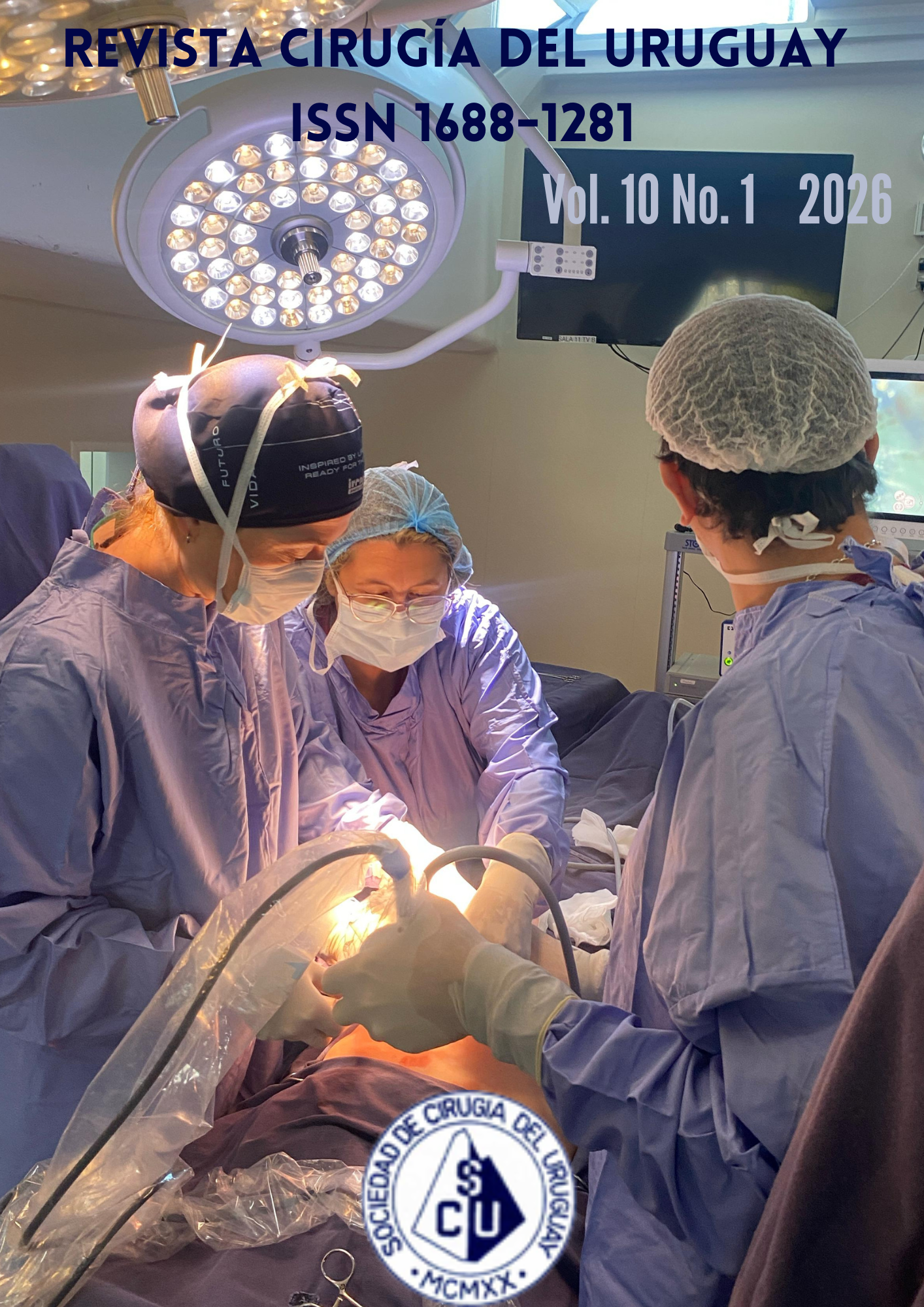
Right hepatectomy in two stages with portal ligation and radiofrequency-assisted liver partitioning (RALPPS) via laparoscopic approach
DOI:
https://doi.org/10.31837/cir.urug/10.1.3Keywords:
liver remodeling surgery, ralpps, laparoscopic right hepatectomy, hepatocellular carcinomaAbstract
Resecability of malignant liver lesions currently depends on future liver remnant. Liver remodeling surgery allow to expand surgical indications. We present the case of a patient with non alcoholic fatty liver disease and a right lobar hepatocellular carcinoma, with an estimated future liver remnant of 23%. A laparoscopic two stage right hepatectomy strategy using portal vein ligation and radiofrequency-assisted liver partition (RALPPS) was performed. The procedure achieved adequate left liver hypertrophy and allowed for safe laparoscopic right hepatectomy without complications. The experience demostrates the feasibility of this hybrid technique and that it is posible to replicate advanced surgical strategies in our setting with the benefits of minimally invasive surgery.
Downloads
References
Makuuchi M, Thai BL, Takayasu K, Takayama T, Kosuge T, Gunvén P, Yamazaki S, Hasegawa H, Ozaki H. Preoperative portal embolization to increase safety of major hepatectomy for hilar bile duct carcinoma: a preliminary report. Surgery, 1990; 107(5), 521-527.
Schlitt HJ, Hackl C, Lang SA. ‘In-situ split’ liver resection ALPPS — historical development and current practice. Visc Med. 2017;33(6):408-12. doi: 10.1159/000479850.
de Santibañes E, Clavien PA. Playing Play-Doh to prevent postoperative liver failure: the “ALPPS” approach. Ann Surg. 2012;255(3):415-7. doi: 10.1097/SLA.0b013e318248577d.
Machado MA, Makdissi FF, Surjan RC. Totally laparoscopic ALPPS is feasible and may be worthwhile. Ann Surg. 2012;256(3):e13. doi: 10.1097/SLA.0b013e318265ff2e.
Li J, Kantas A, Ittrich H, Koops A, Achilles EG, Fischer L, et al. Avoid “all-touch” by hybrid ALPPS to achieve oncological efficacy. Ann Surg. 2016;263(1):e6–7. doi: 10.1097/SLA.0000000000000845
Petrowsky H, Györi G, de Oliveira M, Lesurtel M, Clavien PA. Is partial-ALPPS safer than ALPPS? A single-center experience. Ann Surg. 2015;261(4):e90–2. doi: 10.1097/SLA.0000000000001087.
Clavien PA, Petrowsky H, DeOliveira ML, Graf R. Strategies for safer liver surgery and partial liver transplantation. N Engl J Med. 2007;356(15):1545-59. doi: 10.1056/NEJMra065156.
Vauthey JN, Chaoui A, Do KA, Bilimoria MM, Fenstermacher MJ, Charnsangavej C, et al. Standardized measurement of the future liver remnant prior to extended liver resection: methodology and clinical associations. Surgery. 2000;127(5):512–9. doi: 10.1067/msy.2000.105294.
Knoefel WT, Gabor I, Rehders A, Alexander A, Krausch M, Schulte am Esch J, et. al. In situ liver transection with portal vein ligation for rapid growth of the future liver remnant in two-stage liver resection. Br J Surg. 2013 Feb;100(3):388-94. doi: 10.1002/bjs.8955
Schadde E, Ardiles V, Robles-Campos R, Malago M, Machado M, Hernandez-Alejandro R, et. al. Early survival and safety of ALPPS: first report of the International ALPPS Registry. Ann Surg. 2014 Nov;260(5):829-36; discussion 836-8. doi: 10.1097/SLA.0000000000000947.
Petrowsky H, Györi G, de Oliveira M, Lesurtel M, Clavien PA. Is partial-ALPPS safer than ALPPS? A single-center experience. Ann Surg. 2015;261(4):e90–2.
de Santibañes E, Alvarez FA, Ardiles V, Pekolj J, de Santibañes M. Inverting the ALPPS paradigm by minimizing first stage impact: the Mini-ALPPS technique. Langenbeck’s Arch Surg. 2016;401(4):557–63. doi: 10.1007/s00423-016-1424-1.
Giovanardi ROP. Radiofrequency-assisted ALPPS (RALPPs) for future liver remnant growth: alternative to stage-1 ALPPS. HPB.2023;25(1):S68-S69. doi: 10.1016/j.hpb.2023.05.135
Wang Q, Yan J, Feng X, Chen G, Xia F, Li X, et. al. Safety and efficacy of radiofrequency-assisted ALPPS (RALPPS) in patients with cirrhosis-related hepatocellular carcinoma. Int J Hyperthermia. 2017;33(7):846-852. doi: 10.1080/02656736.2017.1303752.
Downloads
Published
How to Cite
Issue
Section
License

This work is licensed under a Creative Commons Attribution 4.0 International License.
All articles, videos and images published in Revista Cirugía del Uruguay are under the Creative Commons CC licenses, which is a complement to the traditional copyright, in the following terms: first, the authorship of the referred document must always be acknowledged and secondly none of the article or work published in the journal may have commercial purposes of any nature. The authors retain their copyrights and give the magazine the right of first publication of their work, which will be simultaneously subject to the Creative Commons Attribution-NonCommercial 4.0 International License license that allows the work to be shared whenever the initial publication is indicated in this journal.