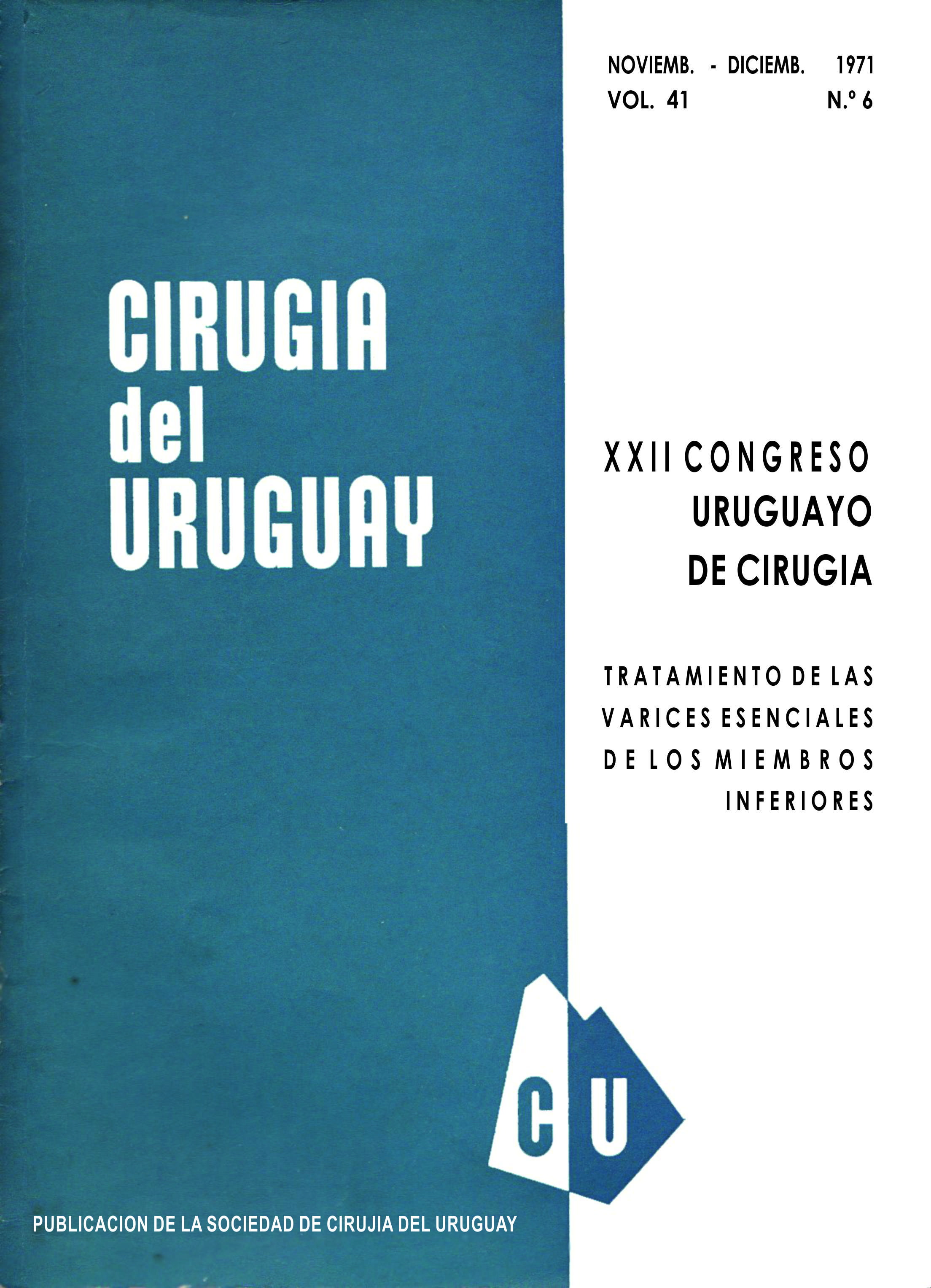
Treatment of essential varicose veins of the lower limbs
Keywords:
varicose veins, vascular surgeryAbstract
1) Therapy of essential varicose veins should be aimed fundamentally at the "elimination of outward flow points" and secondarily, at the elimination of trunks.
This means prior identification of all "outward flow" and their treatment in one single surgical operation.
2) The technique which seems to offer best results is safenous stripping, elimination of collateral varicose veins and ligation of communicants in their place. The plans should proceed along rigurous tactics and techniques. Periodic post-operatory observation should be insisted upon. Surgery-sclerosis association is evaluated.
3) "Nosologic" and "topographic" diagnosis of varicose veins is studied as a basis for deciding on the therapy to be applied. The paper contains a brief analysis of the hemodynamic effects of varicose veins.
4) Anatomic, clinical and therapeutic aspects of the territories of the small and great safenous, communicants and extrapelvic branches of the internal iliac vein, are studied, and an analysis is made of the technical aspects of each case. A procedure for the extirpation of varicose collateral veins is described.
5) The importance of the participation of communicating veins in the venous pathology of the lower limb is stressed,
since insufficiency thereof may also be considered, or may seem, "essential", as is the case of the safenas.
6) An analysis is made of residual, persistent or recurrent varicose veins, resulting from erroneous diagnosis or
treatment, or a combination of both.
Downloads
Downloads
Published
How to Cite
Issue
Section
License
All articles, videos and images published in Revista Cirugía del Uruguay are under the Creative Commons CC licenses, which is a complement to the traditional copyright, in the following terms: first, the authorship of the referred document must always be acknowledged and secondly none of the article or work published in the journal may have commercial purposes of any nature. The authors retain their copyrights and give the magazine the right of first publication of their work, which will be simultaneously subject to the Creative Commons Attribution-NonCommercial 4.0 International License license that allows the work to be shared whenever the initial publication is indicated in this journal.