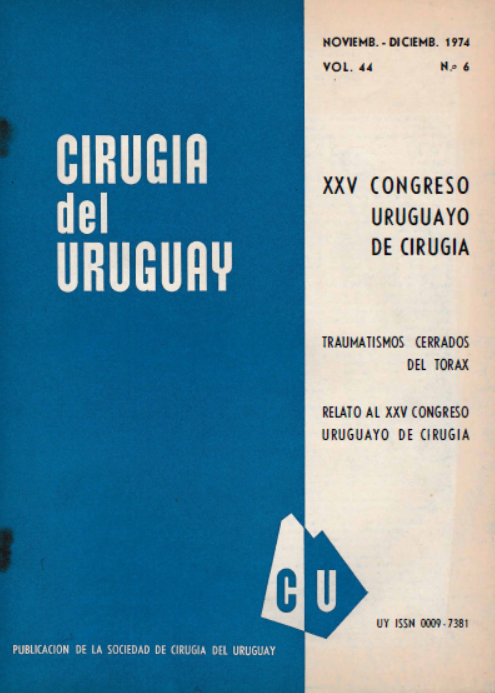
Blunt chest trauma
Relato
Keywords:
traumatisms, toraxAbstract
The modern man lives depending on time and speed. In civilian life the development of highways and fast automobiles has resulted in a great number of seriously traumatized patients. Traffic in large cities has become complex and requires experts to organize same. In 1967, in the United States there were 13 million accidents. Every ten minutes one person dies from injuries, and there is a serious politraumatized case every ten seconds. These figures speak for themselves. In cases of politraumatized patients, serious thorax injury is the most frequent. The requires a precise and immediate examination and treatment, at it has repercussion in vital functions such as respiration, and without oxigen life is
lc;st in a few minutes; cardiac and circulatory functions may also be seriously impaired. An analysis made of the lack of proportion which may exist between a slight attack with great functional difficulties and, sometimes serious traumatisms with apparently important lesions can be managed -saving the life of the injured person- with a therspeutic
measure such as a pleural drainage. The author then explains the functional difficulties which F1ail segments cause, being one of the more serious
injuries in traumatic thorax. The problems as to tretament and risks, as well as the possible complications that rnay arise, were also discussed. Fixed Flail segments and the care that must be given the patient was mentioned, as also the constant observation in case of a possible decompensation. The present trends as to treatment, and the importance of assisted
respiration was also mentioned. Then the author spoke of diaphragmatic rupture, of the difficulty of diagnosis, the permanent anxiety of
a traumatized patient, as to the thype of injury and the complications that may subsequently appear. Mention was made of bronchial obstruction and
rupture of the tracheobronchial tree, adding that this type of injury is deceiving and hides under the frosted glass of pneumothorax, which prevents the doctor
from clearly seeing the evidence. The use of a bronchoscope is of prime importance to reach a correct diagnosis. The author goes on to describe intrathoraxic hemorrhages
-hemothorax and pneumothorax- . As a physician not practicing in specialized centers, preference goes to\-vards puncture and not to drainage of hemothorax. The importance of Pi'renchyma injury, alveolar edema, hemorrhagic suffusions and its significance; lung hematoma, rupture of parenchyma are
described. Thoraco-abdominal injuries, the complexity of diagnosis and the therapeutic problems that may arise, were also mentioned, but always keeping in
mind that, in the face of associated injuries -unless under exceptional circumstances-'- the first thought should be for cardiorespiratory functions. Statistics revea! that the more frequent are 111Junes to herat, pericardium and spleen, and although the author does not have experience in this field, the
subject is constantly in mind and the search is systematic. Injuries to esophagus and amediastinum were discussed, and to conclude an analysis was made of the
principal factors for treatment, on the basis of physioptahological knowledge.
Downloads
Downloads
Published
How to Cite
Issue
Section
License
All articles, videos and images published in Revista Cirugía del Uruguay are under the Creative Commons CC licenses, which is a complement to the traditional copyright, in the following terms: first, the authorship of the referred document must always be acknowledged and secondly none of the article or work published in the journal may have commercial purposes of any nature. The authors retain their copyrights and give the magazine the right of first publication of their work, which will be simultaneously subject to the Creative Commons Attribution-NonCommercial 4.0 International License license that allows the work to be shared whenever the initial publication is indicated in this journal.