Percutaneous abdominal surgery
DOI:
https://doi.org/10.31837/relatos/17Keywords:
abdominal surgery, percutaneous drainage, liver abscesses, splenic abscesses, acute pancreatitis, psoas abscesses, diverticular disease, PERCUTANEOUS CHOLECYSTOSTOMY, percutaneous cholecystostomy, percutaneous biliary drainage, percutaneous biopsiesAbstract
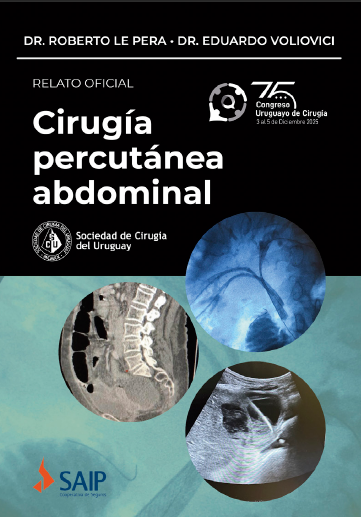
Percutaneous surgery encompasses a wide variety of minimally invasive, image-guided diagnostic and therapeutic procedures that utilize needles, catheters, guidewires, and stents, under the guidance of ultrasound, computed tomography, fluoroscopy, or magnetic resonance imaging. Among the advantages of this approach are a reduced inflammatory response, shorter hospital stay, less postoperative pain, and fewer surgical wound complications. However, it presents a challenge: the need for specialized training and a longer learning curve, both for image interpretation and for mastering the technique.
Downloads
Download data is not yet available.
Downloads
Published
2025-12-08
How to Cite
Le Pera, R., & Voliovici, E. (2025). Percutaneous abdominal surgery. Relatos De Los Congresos Uruguayos De Cirugía, 1–295. https://doi.org/10.31837/relatos/17
Issue
Section
Relato